

In this article
The Complete Guide to Earning Your First Affiliate Commissions
If you've been looking for a way to make money online, you've probably come across affiliate marketing. It's one of the most popular online business models in the world, and for good reason.
Unlike many online businesses, you don't need to create your own product, hold stock, process payments, handle customer support, or worry about shipping orders. Instead, you earn commissions by recommending products and services that other companies sell.
That sounds simple enough, but here's where many beginners get stuck.
They sign up for an affiliate program, grab an affiliate link, post it a few times on social media, and then wonder why nobody clicks or buys.
The truth is that successful affiliate marketing isn't about spamming links across the internet. It's about helping people solve problems, building trust, and recommending products that genuinely make their lives easier.
When done properly, affiliate marketing can become a valuable source of income. Some people use it to generate a little extra spending money each month. Others build full-time businesses around affiliate commissions. The difference usually comes down to strategy, consistency, and understanding how affiliate marketing actually works.
In this beginner's guide, you'll learn exactly what affiliate marketing is, how affiliate programs work, how affiliate links track sales, how to choose profitable niches, and how to create content that generates commissions month after month.
You'll also discover some of the biggest mistakes beginners make, including one that quietly costs many affiliates sales every single day: poorly managed affiliate links.
Whether you're starting a blog, building a YouTube channel, growing a social media following, or creating an email newsletter, this guide will give you a clear roadmap for getting started with affiliate marketing.
By the time you finish reading, you'll understand how affiliate marketing works, how to choose the right affiliate programs, how to attract the right audience, and how to build an affiliate marketing business that can continue generating commissions long after you've published your content.
Why Affiliate Marketing Is Still One of the Best Online Business Models for Beginners
Every year, new online business opportunities appear promising fast results and easy money. Most disappear as quickly as they arrive.
Affiliate marketing is different.
It's been around for decades, it's used by some of the world's biggest companies, and it continues to grow because it creates a win-win situation for everyone involved.
Businesses get new customers.
Customers discover products that help them.
Affiliates earn commissions for making the introduction.
What makes affiliate marketing especially attractive for beginners is the low barrier to entry.
You don't need a warehouse full of products.
You don't need a large advertising budget.
You don't need employees.
You don't even need your own product idea.
Many successful affiliates started with nothing more than a simple website, a YouTube channel, or a social media account dedicated to a topic they enjoyed.
Over time, they created helpful content, built trust with their audience, and recommended products that solved real problems.
That's still the formula that works today.
The tools have changed. The platforms have evolved. Artificial intelligence has entered the picture. But the basic principle remains exactly the same:
Help people make better buying decisions and you'll earn commissions as a result.
That's the foundation of successful affiliate marketing, and it's the approach we'll focus on throughout this guide.
As your affiliate business grows, managing and tracking your affiliate links becomes increasingly important. A surprising number of affiliates lose commissions because links break, merchants change landing pages, or old content points to offers that no longer exist.
Later in this guide, we'll look at how successful affiliates organise, track, and manage their affiliate links, including how tools like GoshLinks can help you create branded links, update destinations without editing old content, and keep your affiliate marketing campaigns running smoothly.
What Is Affiliate Marketing?
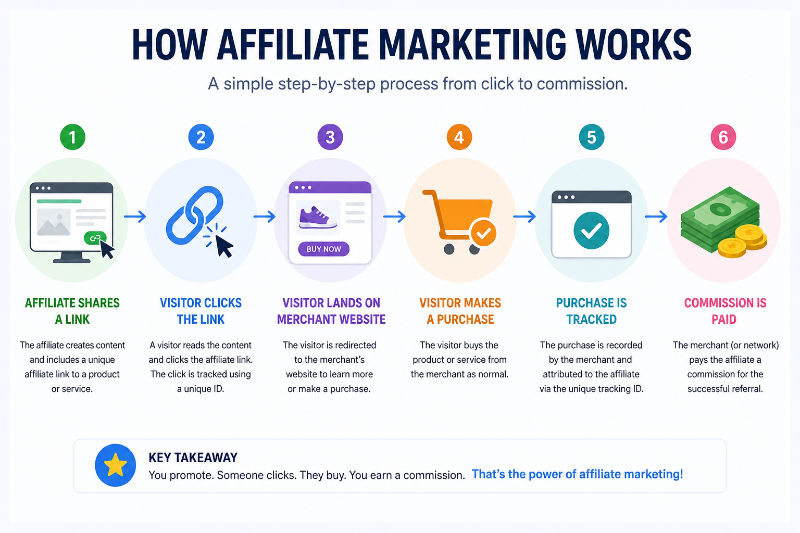
Affiliate marketing is a business model where you earn a commission for recommending another company's products or services.
When somebody clicks your affiliate link and completes a specific action, such as making a purchase or signing up for a service, the company pays you a commission.
Think of it as being a digital salesperson.
The difference is that instead of working for a single company, you can recommend products from many different businesses and earn commissions from all of them.
For example, imagine you run a blog about home coffee brewing.
You write an article called "The Best Coffee Grinders for Beginners" and include affiliate links to several coffee grinders.
A visitor reads your article, clicks one of your affiliate links, and purchases a grinder from the retailer's website.
Because your affiliate link tracked the referral, you receive a commission from the sale.
The customer gets a coffee grinder they wanted.
The retailer gets a new customer.
You earn a commission.
Everyone benefits.
This simple process is the foundation of affiliate marketing.
Once you understand the key players involved, the entire system becomes much easier to understand.
The Four Key Players in Affiliate Marketing
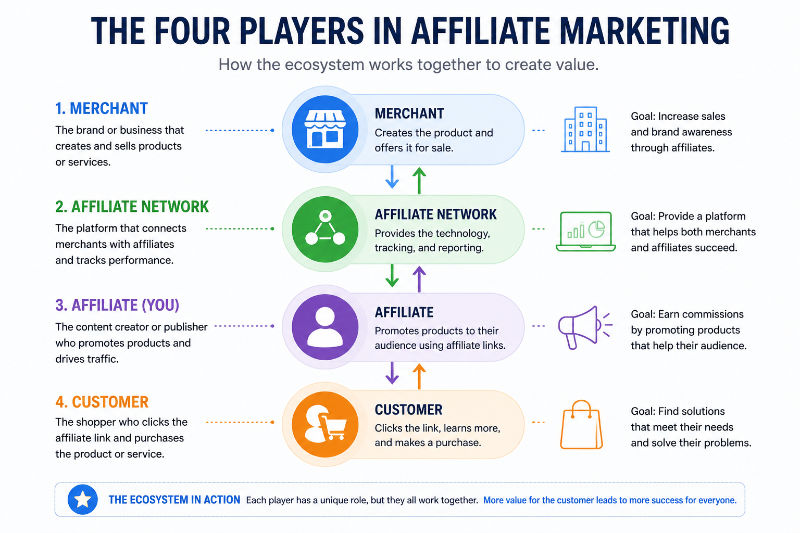
Every affiliate marketing transaction involves four main participants.
1. The Merchant
The merchant is the company selling the product or service.
This could be:
- An online store
- A software company
- A course creator
- A subscription service
- A large retailer
Examples include web hosting companies, online course platforms, software providers, clothing retailers, and thousands of other businesses.
The merchant creates the affiliate program and pays commissions when affiliates generate sales or leads.
Without merchants, there would be no products to promote.
2. The Affiliate
The affiliate is the person promoting the product.
That's the role you'll play.
Affiliates come in all shapes and sizes.
Some run blogs.
Some create YouTube videos.
Others focus on social media, podcasts, email newsletters, or niche websites.
The affiliate's job is not to pressure people into buying.
The most successful affiliates help people make informed purchasing decisions by providing useful information, reviews, tutorials, comparisons, and recommendations.
When readers trust your recommendations, they're more likely to click your affiliate links and make purchases.
3. The Customer
The customer is the person who clicks your affiliate link and takes action.
This might be:
- Buying a product
- Starting a free trial
- Requesting a quote
- Signing up for a service
- Downloading an app
The customer usually pays exactly the same price whether they use your affiliate link or visit the company directly.
The commission comes from the merchant's marketing budget, not from the customer's pocket.
This is one reason affiliate marketing works so well. Customers receive helpful recommendations at no additional cost.
4. The Affiliate Network
Not every affiliate program uses an affiliate network, but many do.
An affiliate network acts as a middleman between merchants and affiliates.
Networks help manage:
- Affiliate tracking
- Reporting
- Payments
- Commission calculations
- Program administration
Instead of joining hundreds of individual affiliate programs, you can often access multiple merchants through a single affiliate network.
Some popular affiliate networks include:
- ShareASale
- CJ Affiliate
- Awin
- Impact
- PartnerStack
We'll look at these platforms in more detail later in this guide.
A Simple Affiliate Marketing Example
Let's walk through a complete example from start to finish.
Imagine Sarah has a website about gardening.
She writes an article titled:
"The Best Garden Hoses for Small Gardens."
Inside the article, she reviews several garden hoses and includes affiliate links to each product.
One of her readers is looking for a new hose.
After reading Sarah's review, the reader clicks her affiliate link and buys a hose for $100.
The retailer pays a 10% commission.
Sarah earns $10.
That may not sound like much, but here's where things get interesting.
The article stays online.
More people find it through Google.
More readers click the affiliate links.
More commissions are generated.
Over time, a single helpful article can generate affiliate income for months or even years.
That's one of the biggest advantages of affiliate marketing.
Instead of constantly trading time for money, you create content that can continue attracting visitors and generating commissions long after it's published.
Why Affiliate Marketing Appeals to Beginners
Many online business models require significant upfront investment.
You may need inventory.
You may need specialised equipment.
You may need staff.
You may need customer support systems.
Affiliate marketing removes many of those barriers.
You can often get started with:
- A website
- A YouTube channel
- A social media account
- An email newsletter
Many affiliate programs are free to join.
That means you can start learning and building experience without risking large amounts of money.
Of course, that doesn't mean affiliate marketing is easy.
Building trust takes time.
Creating quality content takes effort.
Learning search engine optimisation, content marketing, email marketing, and audience building takes patience.
But compared to many other business models, affiliate marketing remains one of the most accessible ways for beginners to start building an online income stream.
Affiliate Marketing Is Not a Get-Rich-Quick Scheme
This is probably the most important lesson in this entire guide.
Affiliate marketing works.
But it works because it provides value.
Many beginners make the mistake of focusing entirely on commissions.
They ask questions like:
- Which affiliate program pays the most?
- Which products have the highest commissions?
- How can I make money quickly?
The better question is:
How can I help people solve a problem?
The affiliates who consistently earn commissions are usually the ones who create genuinely useful content.
They answer questions.
They test products.
They share experiences.
They save people time.
They help buyers avoid expensive mistakes.
The commission is simply the reward for providing that value.
If you approach affiliate marketing with that mindset from the beginning, you'll already be ahead of many new affiliates entering the industry.
Now that you understand what affiliate marketing is and who the key players are, let's look at exactly how affiliate marketing works behind the scenes, including how affiliate links track clicks, sales, and commissions.
How Affiliate Marketing Works
Now that you understand the basic concept of affiliate marketing, let's look at what actually happens behind the scenes.
At first glance, affiliate marketing seems incredibly simple.
You share a link.
Someone clicks it.
They buy something.
You earn a commission.
While that's true, there's quite a bit of technology working in the background to make sure sales are tracked correctly and commissions are paid to the right affiliate.
Understanding this process will help you make better decisions as you grow your affiliate marketing business.
The Affiliate Marketing Process Step by Step
Most affiliate marketing transactions follow the same basic path.
Step 1: Join an Affiliate Program
The first step is joining an affiliate program.
When your application is approved, you'll gain access to a dashboard where you can generate affiliate links, view reports, and monitor your commissions.
Some affiliate programs approve applications instantly.
Others manually review applicants to make sure their content and audience are a good fit.
Depending on the company, you may be given access to:
- Affiliate links
- Banner advertisements
- Product images
- Marketing resources
- Performance reports
- Promotional materials
Once you're approved, you're ready to start promoting products.
Step 2: Receive Your Unique Affiliate Link
Every affiliate receives a unique tracking link.
This link contains information that identifies you as the referring affiliate.
A standard affiliate link might look something like this:
https://example.com/product?affiliate=12345
When someone clicks this link, the tracking system records that you referred the visitor.
The visitor is then sent to the merchant's website as normal.
The customer usually doesn't notice anything unusual happening.
Everything works seamlessly in the background.
Step 3: A Visitor Clicks Your Affiliate Link
Let's imagine you have a blog about camping equipment.
You publish an article reviewing a popular tent and include your affiliate link.
A visitor finds your article through Google, reads your review, and clicks the link to learn more about the tent.
At that moment, the affiliate tracking system records important information such as:
- Which affiliate referred the visitor
- Which link was clicked
- The date and time of the click
- The campaign being used
- The destination page
This information helps ensure that any resulting sale is credited to the correct affiliate.
Step 4: A Tracking Cookie Is Created
After the click, a small tracking file called a cookie is usually stored in the visitor's browser.
The cookie acts like a temporary note that says:
"This visitor was referred by Affiliate #12345."
Cookies allow affiliate programs to track sales even if the customer doesn't buy immediately.
For example, someone might:
- Click your affiliate link today
- Read product information
- Leave the website
- Return three days later
- Complete the purchase
If the cookie is still active, you'll generally receive credit for the sale.
This is known as the cookie duration or cookie window.
What Is a Cookie Duration?
Every affiliate program sets its own cookie duration.
Some common examples include:
- 24 hours
- 7 days
- 30 days
- 60 days
- 90 days
A 30-day cookie means you can still receive a commission if the customer purchases within 30 days of clicking your affiliate link.
Longer cookie durations are generally more attractive because they give customers more time to make buying decisions.
This is particularly important for expensive products where people often spend days or weeks researching before purchasing.
Step 5: The Customer Completes a Purchase
If the customer decides to buy, the affiliate tracking system checks whether a valid affiliate referral exists.
If it does, the system attributes the sale to the affiliate who referred the customer.
The commission is then recorded in the affiliate dashboard.
Depending on the program, commissions may be marked as:
- Pending
- Approved
- Paid
Many companies have a waiting period before commissions are approved. This allows time for refunds, cancellations, or chargebacks.
Once the approval period passes, the commission becomes payable.
Step 6: You Get Paid
After enough approved commissions accumulate, the affiliate program sends payment.
Payment methods vary but commonly include:
- Bank transfer
- PayPal
- Wise
- Direct deposit
- Cheque
Most programs pay monthly, although some operate on different schedules.
Congratulations. You've just completed the affiliate marketing cycle.
Now let's look at what determines how much you can actually earn.
Different Types of Affiliate Commissions
Not all affiliate programs pay commissions the same way.
Understanding the different commission structures can help you choose the right affiliate programs for your audience.
Pay Per Sale (PPS)
This is the most common affiliate commission model.
You earn a percentage or fixed amount whenever someone purchases a product through your affiliate link.
Examples:
- A $100 product with a 10% commission earns you $10.
- A $500 product with a 20% commission earns you $100.
Most physical product affiliate programs use this model.
Pay Per Lead (PPL)
With pay-per-lead programs, you earn money when someone completes a specific action.
This could include:
- Filling out a form
- Requesting a quote
- Starting a free trial
- Signing up for a webinar
- Creating an account
The customer doesn't necessarily have to purchase anything.
Recurring Commissions
Recurring commissions are popular among software and subscription-based businesses.
Instead of earning a commission once, you continue earning while the customer remains subscribed.
For example:
- Customer pays $50 per month.
- Affiliate commission is 30%.
- You earn $15 every month.
If the customer stays for two years, that single referral becomes significantly more valuable.
Many experienced affiliates actively seek recurring commission programs because they create more predictable long-term income.
Why Affiliate Tracking Matters More Than Most Beginners Realise
Many new affiliates focus entirely on traffic and commissions.
Very few think about tracking.
That's a mistake.
Imagine you have:
- 50 blog posts
- 100 affiliate links
- Multiple affiliate programs
- Several social media accounts
- An email newsletter
Managing all those links manually quickly becomes difficult.
Now imagine a merchant changes a landing page or updates an offer.
If your affiliate links are scattered across dozens of articles, videos, emails, and social media posts, updating them can become a nightmare.
This is why experienced affiliates pay close attention to link management and tracking.
Good tracking helps you understand:
- Which articles generate sales
- Which campaigns perform best
- Which traffic sources convert
- Which affiliate links attract the most clicks
Just as importantly, proper link management helps ensure that visitors always reach the correct destination.
Why Many Affiliates Use Branded Links
As affiliate businesses grow, many marketers move away from displaying long, ugly affiliate URLs.
Instead, they create branded links.
For example, instead of sharing:
https://affiliate-network.com/product?id=837264&affiliate=9283
they might use:
yoursite.com/go/recommended-tent
or
yoursite.com/to/best-hosting
Branded links look cleaner, are easier to remember, and can improve trust because visitors can immediately see the link belongs to your brand.
They also provide another major advantage.
If the destination URL ever changes, you can update the target without changing the link you've already shared across your content.
Tools such as GoshLinks were designed specifically to solve this problem by allowing affiliates to create branded short links, organise campaigns, track clicks, and update destinations from a single dashboard.
We'll explore affiliate link management in much greater detail later in this guide because it becomes increasingly important as your content library grows.
For now, the key takeaway is simple:
Affiliate marketing isn't just about generating clicks. It's about tracking those clicks accurately, understanding where your sales come from, and making sure your links continue working long after you've published your content.
Now that you understand how affiliate marketing works behind the scenes, let's look at why businesses invest millions of dollars into affiliate programs and why so many companies actively recruit affiliates to promote their products.
Why Companies Use Affiliate Marketing
At this point, you might be wondering why companies are willing to pay commissions to affiliates at all.
After all, if a business can sell directly to customers through its own website, why share part of the revenue with somebody else?
The answer is simple.
Affiliate marketing is one of the most cost-effective forms of marketing available.
Unlike traditional advertising, businesses only pay when results are generated.
If an affiliate sends no visitors and produces no sales, the merchant pays nothing.
This makes affiliate marketing a low-risk, high-reward marketing channel for companies of all sizes.
In fact, many businesses actively invest in growing their affiliate programs because they know affiliates can help them reach audiences they might never reach on their own.
Let's look at the main reasons companies love affiliate marketing.
Businesses Only Pay for Results
Imagine a company spends $5,000 on advertising.
There's no guarantee the campaign will generate sales.
The business takes all the risk.
Affiliate marketing works differently.
Instead of paying upfront, the company only pays when a desired action occurs.
That action could be:
- A sale
- A lead
- A free trial signup
- An account registration
- A booked consultation
Because payment is tied directly to performance, affiliate marketing is often one of the most efficient customer acquisition channels available.
The company gains customers.
The affiliate earns commissions.
Everyone wins.
Affiliates Help Businesses Reach New Audiences
Every affiliate has their own audience.
Some have blogs.
Some have YouTube channels.
Some have social media followings.
Others have email newsletters or online communities.
When affiliates recommend products to their audiences, they introduce businesses to potential customers who may never have discovered the company otherwise.
For example:
A gardening blogger can introduce thousands of gardeners to a new tool manufacturer.
A fitness YouTuber can introduce gym enthusiasts to a supplement company.
A technology reviewer can introduce software products to business owners.
This audience expansion is one of the biggest reasons companies invest heavily in affiliate marketing programs.
Trust Transfers Through Recommendations
People are becoming increasingly sceptical of advertising.
We're exposed to thousands of advertisements every day.
Most are ignored.
Recommendations work differently.
When somebody follows a creator, reads a blog regularly, or subscribes to a newsletter, a level of trust develops over time.
If that creator recommends a product they've genuinely used and found helpful, the recommendation often carries far more weight than a traditional advertisement.
This trust is incredibly valuable to businesses.
Many companies would rather pay an affiliate commission than spend significantly more on advertising that people simply scroll past.
Affiliate Marketing Is Highly Scalable
One salesperson can only talk to so many customers.
One advertising campaign can only reach a limited audience.
Affiliate marketing scales much more efficiently.
A company can recruit:
- 10 affiliates
- 100 affiliates
- 1,000 affiliates
- 10,000 affiliates
Each affiliate becomes a potential source of new customers.
This allows businesses to grow their marketing reach without needing to hire large sales teams.
The affiliates essentially become an extended marketing force working on a performance basis.
Why Some Companies Pay Very High Commissions
One question beginners often ask is:
"Why would a company pay 30%, 40%, or even 50% commissions?"
The answer usually comes down to customer lifetime value.
Let's say a software company charges $50 per month for its service.
A typical customer remains subscribed for two years.
That customer is worth:
$50 × 24 months = $1,200
If the company pays an affiliate a $200 commission to acquire that customer, it can still be highly profitable.
This is why software, web hosting, online courses, membership sites, and subscription businesses often offer some of the highest affiliate commissions available.
They know the long-term value of the customer exceeds the initial commission payout.
Why Some Affiliate Programs Reject Applicants
Not every affiliate application is approved.
Some companies carefully review potential affiliates before granting access to their program.
This is especially common in industries where brand reputation matters.
A merchant may review:
- Your website
- Your content quality
- Your traffic sources
- Your audience
- Your promotional methods
They're looking for affiliates who will represent their brand professionally and ethically.
If you're just starting out, don't be discouraged by occasional rejections.
Many affiliate programs are beginner-friendly, and as your content grows, more opportunities become available.
The Best Affiliates Think Like Business Owners
Understanding why merchants use affiliate marketing gives you an important advantage.
Many beginners view affiliate marketing purely from their own perspective.
They focus on:
- Commissions
- Traffic
- Earnings
Successful affiliates take a broader view.
They ask questions such as:
- Will this product genuinely help my audience?
- Would I recommend this if there were no commission involved?
- How can I help the merchant generate more sales?
- How can I create better content than my competitors?
When you start thinking like both an affiliate and a business owner, your content naturally becomes more valuable.
That value leads to more trust.
More trust leads to more clicks.
More clicks lead to more commissions.
Why Trust Is the Real Currency in Affiliate Marketing
The biggest mistake new affiliates make is believing that affiliate marketing is about links.
It isn't.
Affiliate links are simply the mechanism used to track referrals.
Trust is what actually drives sales.
Think about your own buying habits.
If a complete stranger recommends a product, you're probably cautious.
If somebody you've followed for months consistently provides useful information and then recommends a product, you're far more likely to listen.
That's exactly how affiliate marketing works.
The affiliate link tracks the sale.
The trust creates the sale.
This is why the best affiliates spend most of their time creating helpful content rather than chasing shortcuts.
They're building relationships.
They're building credibility.
They're building an audience that values their recommendations.
The commissions are simply a by-product of that trust.
Now that you understand why companies use affiliate marketing and why trust plays such a critical role, let's look at the different types of affiliate marketing and discover which approach tends to produce the best long-term results for beginners.
Types of Affiliate Marketing
Not all affiliate marketers operate in the same way.
Some build businesses around products they've never used.
Others only recommend products they personally rely on every day.
Some focus entirely on paid advertising.
Others create content that attracts visitors from search engines, YouTube, social media, or email marketing.
Understanding the different types of affiliate marketing can help you decide which approach is right for you.
More importantly, it can help you avoid some of the common mistakes that cause beginners to struggle.
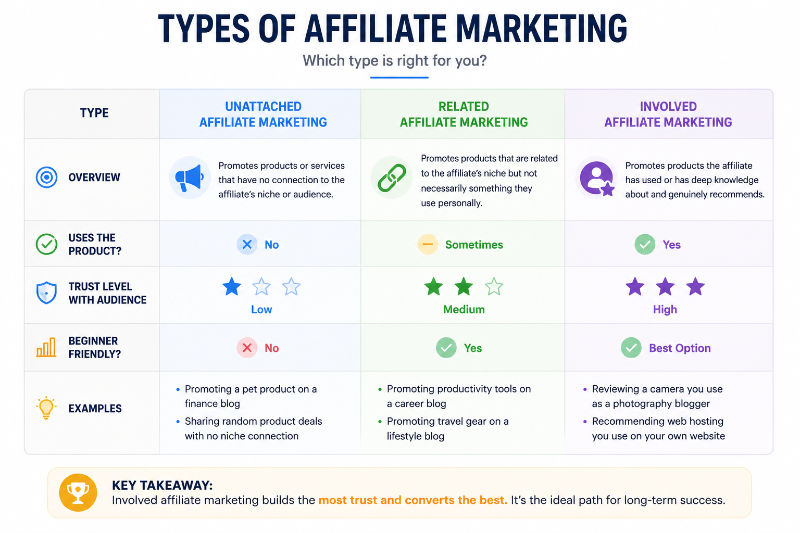
While there are many ways to categorise affiliate marketing, most affiliate strategies fall into three main groups.
Unattached Affiliate Marketing
Unattached affiliate marketing is the most hands-off approach.
In this model, the affiliate has little or no connection to the product they're promoting.
They may never have used the product.
They may not even have personal experience in the niche.
Their primary goal is simply to drive traffic to affiliate offers.
This often involves:
- Paid advertising
- Search engine ads
- Social media ads
- Landing pages
- Funnel-based marketing
For example, someone might run Google Ads promoting a web hosting company without ever having built a website themselves.
Their success depends on understanding advertising, conversions, and campaign optimisation rather than personal expertise.
Advantages of Unattached Affiliate Marketing
- Fast to get started
- No need to build a personal brand
- Can work across many niches
- Highly scalable if advertising campaigns are profitable
Disadvantages of Unattached Affiliate Marketing
- Lower trust levels
- Higher competition
- Advertising costs can become expensive
- Difficult for beginners
- Often produces lower conversion rates
For most beginners, unattached affiliate marketing is not the best place to start.
It requires strong marketing skills and often significant advertising budgets.
Without experience, it's easy to spend more on ads than you earn in commissions.
Related Affiliate Marketing
Related affiliate marketing sits somewhere in the middle.
The affiliate operates within a niche and has some level of authority or audience, but they may not have personally used every product they recommend.
For example:
A gardening blogger might review a new garden tool based on research, specifications, customer reviews, and manufacturer information.
The blogger understands gardening and has an audience interested in gardening, but may not have personally tested every product featured in every article.
This approach is extremely common.
Many large review websites operate this way.
Advantages of Related Affiliate Marketing
- Easier to create content consistently
- Allows broader product coverage
- Builds authority within a niche
- Doesn't require purchasing every product
Disadvantages of Related Affiliate Marketing
- Lower credibility than personal experience
- Reviews may feel less authentic
- Harder to stand out from competitors
Related affiliate marketing can work very well when combined with honest research and transparent recommendations.
However, there is still an even more powerful approach.
Involved Affiliate Marketing
Involved affiliate marketing is generally considered the gold standard.
In this model, affiliates only recommend products they have personally used, tested, or experienced.
Their recommendations come from genuine experience rather than simply researching information online.
For example:
A photographer reviews cameras they personally own.
A fitness coach recommends equipment they use daily.
An artist reviews paints, pencils, and brushes they've actually tested.
Their audience benefits from real-world insights that can't easily be found elsewhere.
This creates a much stronger level of trust.
Advantages of Involved Affiliate Marketing
- Higher credibility
- Greater audience trust
- Better conversion rates
- More authentic content
- Stronger long-term brand building
Disadvantages of Involved Affiliate Marketing
- Takes longer to create content
- May require purchasing products
- Limits how many products can be reviewed
Despite these challenges, involved affiliate marketing is often the most sustainable long-term strategy.
When readers believe your recommendations are genuine, they're far more likely to trust future recommendations as well.
Which Type of Affiliate Marketing Is Best for Beginners?
For most people starting affiliate marketing today, involved affiliate marketing offers the best opportunity for long-term success.
Why?
Because trust has become increasingly important online.
Consumers have access to endless information.
Artificial intelligence can generate thousands of articles.
Review sites are everywhere.
People are becoming better at spotting content created purely to earn commissions.
What remains valuable is genuine experience.
If you've actually used a product, solved a problem, achieved a result, or learned a valuable lesson, your content becomes more useful.
And useful content tends to perform better in:
- Google search results
- YouTube recommendations
- Social media sharing
- Email engagement
Trust compounds over time.
Every helpful recommendation strengthens your reputation.
Every poor recommendation damages it.
The most successful affiliates understand this and protect their credibility carefully.
The Rise of Personal Brands in Affiliate Marketing
Ten years ago, many affiliate marketers focused almost entirely on websites.
Today, personal brands are becoming increasingly important.
People often prefer learning from people rather than anonymous websites.
That's why so many successful affiliates build audiences through:
- YouTube channels
- Podcasts
- Email newsletters
- Facebook groups
- Instagram accounts
- LinkedIn profiles
- Blogs
Their audience gets to know them.
Trust develops naturally.
Recommendations become more valuable.
This doesn't mean you need to become an influencer.
It simply means your expertise, experience, and personality can become significant competitive advantages.
Why Niche Expertise Matters
One of the biggest advantages beginners have is niche expertise.
You don't need to know everything.
You only need to know more than the people you're helping.
Consider these examples:
- A gardener helping new gardeners.
- A home coffee enthusiast helping beginners make better coffee.
- An artist helping new artists choose supplies.
- A camper helping families choose camping equipment.
- A blogger helping small businesses choose software.
Each person has valuable knowledge that can help others make better buying decisions.
That knowledge becomes the foundation of effective affiliate content.
The Most Successful Affiliates Blend All Three Approaches
While we've discussed three separate categories, many successful affiliates combine elements of each.
They may:
- Personally test their favourite products.
- Research additional products in their niche.
- Occasionally use paid advertising to amplify successful content.
The key is maintaining trust.
Whenever recommendations become purely commission-driven, audiences eventually notice.
The affiliates who thrive long-term focus on helping first and selling second.
That's why many of the most successful affiliate marketers earn commissions year after year.
They've built audiences that genuinely value their advice.
Now that you understand the different types of affiliate marketing, the next step is choosing where you'll actually find affiliate programs. Let's look at some of the best affiliate marketing platforms and networks available to beginners and how to decide which ones deserve your attention.
Best Affiliate Marketing Platforms for Beginners
Once you've decided to start affiliate marketing, the next question is usually:
"Where do I find affiliate programs?"
The good news is that there are thousands of affiliate programs available across almost every niche imaginable.
Whether you're interested in technology, gardening, fitness, travel, finance, art, photography, cooking, or business, there's a good chance companies in your niche already have affiliate programs you can join.
There are two main ways to find affiliate programs:
- Join individual affiliate programs run directly by companies.
- Join affiliate networks that provide access to multiple merchants through a single account.
Both approaches can work well, and many successful affiliates use a combination of the two.
Direct Affiliate Programs
Some companies manage their own affiliate programs.
Instead of joining through a network, you apply directly on the company's website.
Examples include:
- Software companies
- Membership platforms
- Course creators
- Web hosting companies
- SaaS businesses
Direct programs often provide:
- Higher commissions
- Better support
- Exclusive promotions
- Direct communication with affiliate managers
The downside is that managing multiple direct affiliate programs can become time-consuming as your business grows.
You may end up logging into dozens of different dashboards to check performance and commissions.
Affiliate Networks
Affiliate networks act as marketplaces that connect affiliates with merchants.
Instead of joining each program separately, you create one account and gain access to multiple affiliate programs.
Networks typically handle:
- Tracking
- Reporting
- Payments
- Commission management
- Merchant applications
This makes them especially attractive for beginners.
Let's look at some of the most popular affiliate networks.
ShareASale
ShareASale has been one of the most popular affiliate networks for many years.
It offers access to thousands of merchants across a wide range of industries.
Popular categories include:
- Home and garden
- Business software
- Fashion
- Education
- Technology
- Lifestyle products
For beginners, ShareASale is often one of the easiest places to start because of its large selection of merchants.
CJ Affiliate
CJ Affiliate, formerly known as Commission Junction, is one of the largest affiliate networks in the world.
Many major brands use CJ to manage their affiliate programs.
You'll find opportunities across industries such as:
- Retail
- Travel
- Finance
- Technology
- Business services
CJ can be highly profitable, although some programs have stricter approval requirements than beginner-friendly networks.
Awin
Awin is another large affiliate network with thousands of merchants worldwide.
It's particularly strong in:
- Retail
- Fashion
- Travel
- Financial services
- Consumer products
Awin offers both well-known global brands and smaller niche merchants.
This makes it a useful platform as your affiliate marketing experience grows.
Impact
Impact has become increasingly popular, especially among software companies and online businesses.
Many modern SaaS companies use Impact to manage their affiliate partnerships.
If you're interested in promoting software products, business tools, or online services, Impact is worth exploring.
PartnerStack
PartnerStack focuses heavily on software and subscription-based businesses.
Many companies on the platform offer recurring commissions.
This means you can continue earning commissions while the customer remains subscribed.
For affiliates interested in promoting business software, marketing tools, or productivity applications, PartnerStack can be particularly attractive.
Amazon Associates
No discussion about affiliate marketing platforms would be complete without mentioning Amazon Associates.
Amazon's affiliate program allows you to earn commissions on millions of products.
The advantages include:
- Huge product selection
- High consumer trust
- Easy approval process
- Strong conversion rates
The disadvantages include:
- Lower commission percentages
- Short cookie duration
- Frequent program changes
Despite these limitations, Amazon Associates remains one of the easiest affiliate programs for beginners to understand and use.
Many affiliates earn their first commissions through Amazon.
Which Affiliate Platform Should Beginners Choose?
Many beginners make the mistake of searching for the highest commission percentages.
That's understandable, but it's usually the wrong approach.
A product that pays a 50% commission is worthless if nobody wants to buy it.
Instead, focus on three factors:
Relevance
The products should fit your audience.
A gardening audience doesn't want software recommendations.
A photography audience probably isn't looking for camping gear.
The closer the match between audience and product, the better your results are likely to be.
Trustworthiness
Only promote products from companies you trust.
Your reputation is more valuable than any single commission.
A poor recommendation may generate one sale today but cost you dozens of future sales.
Conversion Potential
Some products naturally convert better than others.
Products that solve clear problems often perform well because buyers already have a strong motivation to purchase.
For example:
- Website hosting for new website owners
- Accounting software for businesses
- Art supplies for artists
- Fitness equipment for fitness enthusiasts
The stronger the problem being solved, the easier it is to generate affiliate commissions.
How to Find Affiliate Programs in Any Niche
One of the simplest techniques is using Google.
Try searches such as:
- gardening affiliate programs
- photography affiliate programs
- fitness affiliate programs
- software affiliate programs
- art supplies affiliate programs
You can also search:
- [industry] + affiliate program
- [company name] + affiliate program
- [product name] + affiliate program
Many excellent affiliate opportunities can be found this way.
Don't Join Too Many Affiliate Programs Too Soon
This is a common beginner mistake.
New affiliates often join:
- 20 affiliate programs
- 30 affiliate programs
- 50 affiliate programs
Then they become overwhelmed.
It's usually far better to start with a small number of quality programs and learn how they work.
Focus on:
- Products you understand
- Products relevant to your audience
- Companies you trust
As your website, channel, or audience grows, you can expand your portfolio gradually.
The Best Affiliate Program Is the One That Helps Your Audience
Successful affiliate marketers don't start by asking:
"Which program pays the highest commission?"
They start by asking:
"What does my audience need help with?"
Once you know the answer to that question, choosing affiliate programs becomes much easier.
Find products that solve those problems.
Recommend them honestly.
Create helpful content around them.
That's the formula that tends to produce long-term affiliate income.
Now that you know where to find affiliate programs, the next challenge is choosing a niche. This decision can have a huge impact on your future success, so let's look at how to choose a profitable affiliate marketing niche that gives you the best chance of building a sustainable business.
Choosing a Profitable Affiliate Marketing Niche
One of the biggest decisions you'll make as an affiliate marketer happens before you publish your first piece of content.
It's choosing your niche.
Get this decision right and content creation becomes easier, audience building becomes more natural, and generating affiliate commissions becomes much more achievable.
Get it wrong and you'll spend months creating content for products nobody wants to buy.
Many beginners overthink niche selection.
They spend weeks trying to find the "perfect niche" when they would be better off creating content and gaining experience.
The truth is that a good niche doesn't need to be perfect.
It simply needs to meet a few important criteria.
What Is a Niche?
A niche is a specific topic or market segment that you'll focus on.
For example:
- Gardening
- Photography
- Fitness
- Cooking
- Personal finance
- Travel
- Art
However, broad topics are often difficult to compete in.
A niche becomes stronger when it's more focused.
For example:
- Vegetable gardening
- Landscape photography
- Home fitness
- Budget travel
- Watercolour painting
- RV camping
- Small business accounting
The more focused your niche, the easier it becomes to attract a targeted audience.
Why Broad Niches Are Difficult for Beginners
Imagine starting a website about "fitness."
You're competing against:
- Major fitness brands
- Professional trainers
- Large media companies
- Established fitness websites
That's a tough battle.
Now imagine focusing on:
Home Workouts for Busy Parents
Suddenly your audience becomes more specific.
Your content becomes more targeted.
Your recommendations become more relevant.
Your chances of building authority increase significantly.
This is why narrowing your niche is often one of the smartest moves a beginner can make.
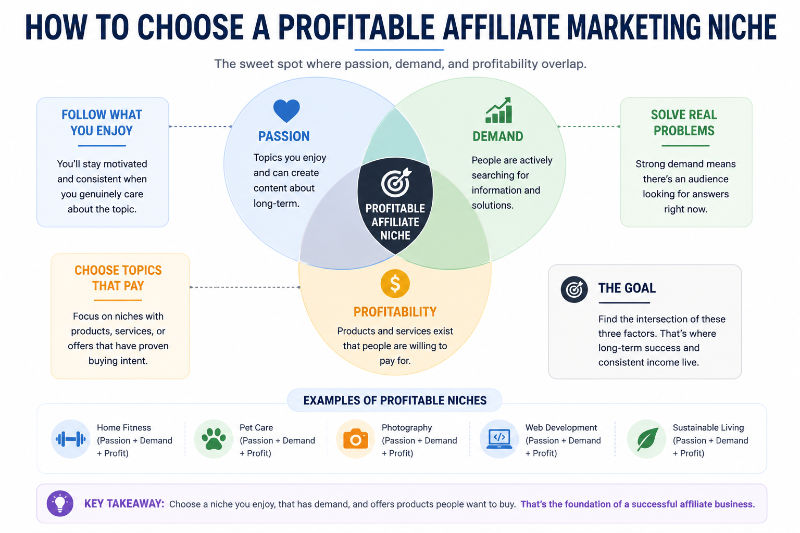
The Three Ingredients of a Profitable Niche
The strongest affiliate marketing niches usually sit at the intersection of three factors:
Audience Interest
People need to care about the topic.
If nobody is searching for information, it becomes difficult to attract traffic.
You want a niche where people actively seek:
- Advice
- Reviews
- Recommendations
- Tutorials
- Comparisons
Commercial Intent
People need to buy products within the niche.
This is where many beginners go wrong.
A topic might attract plenty of visitors but have very little buying activity.
For example, a niche with strong interest but few products may struggle to generate meaningful affiliate income.
A profitable affiliate niche usually contains products, services, tools, subscriptions, or equipment that people regularly purchase.
Long-Term Interest
Choose a niche you can see yourself writing about for years.
Affiliate marketing rarely succeeds overnight.
The best results often come from publishing useful content consistently over time.
If you lose interest after ten articles, building authority becomes difficult.
Start With What You Already Know
Many successful affiliates begin with hobbies, interests, careers, or personal experiences.
This gives them a significant advantage.
You don't need to be the world's leading expert.
You simply need to know enough to help people who are a few steps behind you.
For example:
- A gardener can help new gardeners.
- A photographer can help beginner photographers.
- A small business owner can help new entrepreneurs.
- An artist can help aspiring artists.
Your experience allows you to create content that feels authentic rather than generic.
Good Affiliate Marketing Niche Examples
Let's look at some examples of niches that tend to perform well.
Technology
Technology remains one of the most popular affiliate marketing categories.
Potential products include:
- Laptops
- Cameras
- Software
- Web hosting
- Online tools
- Accessories
Technology buyers often research heavily before purchasing, which creates opportunities for reviews and comparison content.
Home and Garden
Home improvement and gardening are excellent affiliate niches.
Potential products include:
- Tools
- Equipment
- Plants
- Furniture
- Irrigation systems
- Outdoor products
Many purchases are driven by specific problems, making recommendation content highly effective.
Art and Creative Hobbies
Creative niches often perform well because enthusiasts regularly purchase supplies.
Examples include:
- Drawing materials
- Paints
- Easels
- Brushes
- Craft equipment
- Digital art tools
People entering creative hobbies frequently search for buying advice before investing in equipment.
Business and Marketing
Business-focused niches can be highly profitable.
Potential affiliate products include:
- Software subscriptions
- Website hosting
- Email marketing tools
- SEO platforms
- Productivity software
- Online courses
Many business products offer recurring commissions, making them attractive to affiliate marketers.
Health and Fitness
Fitness remains one of the largest affiliate markets online.
Potential opportunities include:
- Exercise equipment
- Fitness apps
- Nutrition products
- Training programs
- Sports equipment
Because buyers are often actively seeking solutions, well-written content can perform extremely well.
Niche Ideas That Beginners Often Overlook
Many new affiliates focus on highly competitive markets.
Sometimes smaller niches offer better opportunities.
Consider topics such as:
- Bird watching
- Woodworking
- Home brewing
- Fishing
- Calligraphy
- Model building
- Indoor plants
- Board games
- Hiking
- Pet care
These niches often have passionate audiences and strong purchasing behaviour.
Signs You've Chosen a Good Niche
A good niche usually produces several positive signals.
You can easily think of article ideas.
You enjoy learning about the topic.
People ask questions about it.
Products exist that solve common problems.
Companies operate affiliate programs within the niche.
The niche contains active communities, forums, YouTube channels, and social media groups.
These are all encouraging signs.
Signs You May Need to Reconsider
A niche may be problematic if:
- You have no interest in the topic.
- Very few products exist.
- Nobody searches for information about it.
- You struggle to generate content ideas.
- There are limited affiliate opportunities.
This doesn't automatically mean the niche is impossible, but it may require more effort to build successfully.
Your Niche Doesn't Need to Be Perfect
One mistake stops many people from getting started.
They spend months searching for the perfect niche.
The reality is that most successful affiliates refine their focus over time.
You might start broadly and later specialise.
You might discover unexpected opportunities through your audience.
You might uncover sub-niches that perform better than your original idea.
That's normal.
Taking action is far more valuable than endless planning.
Build Around Problems, Not Products
This may be the most important niche selection tip in the entire guide.
Don't build a website around products.
Build it around problems.
People don't search for products because they enjoy shopping.
They search because they want solutions.
For example:
People don't want a drill.
They want a hole in the wall.
People don't want accounting software.
They want easier bookkeeping.
People don't want art supplies.
They want to create better artwork.
When you focus on solving problems, your content naturally becomes more helpful.
Helpful content builds trust.
Trust drives affiliate sales.
Think Beyond Your First Affiliate Commission
When choosing a niche, don't ask:
"Can I make a commission here?"
Ask:
"Can I build hundreds of useful pieces of content here?"
That's the mindset that creates long-term affiliate businesses.
The most successful affiliates think like publishers.
They focus on helping their audience over the long term rather than chasing quick wins.
Choose a niche where you can continue providing value for years, and you'll give yourself a much stronger foundation for success.
Now that you've chosen a niche and joined some affiliate programs, the next challenge is attracting visitors. Let's look at the types of content that consistently generate affiliate sales and why some content converts dramatically better than others.
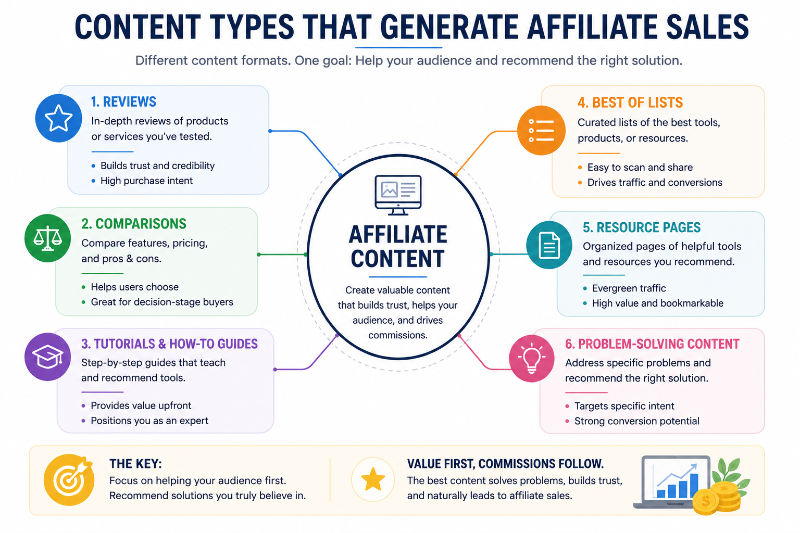
Content That Actually Generates Affiliate Sales
Many beginners assume affiliate marketing is primarily about finding products to promote.
It's not.
The real job of an affiliate marketer is creating content that helps people make buying decisions.
Without content, there are very few opportunities for people to discover your affiliate links.
This is why content sits at the centre of almost every successful affiliate marketing business.
Whether you're creating blog posts, YouTube videos, social media content, podcasts, or email newsletters, the goal remains the same:
Help people solve problems and make better decisions.
The good news is that not all content performs equally.
Some content types consistently generate more affiliate sales than others.
Let's look at the formats that tend to work best.
Product Reviews
Product reviews are one of the oldest and most effective forms of affiliate content.
People often search for reviews when they're close to making a purchase.
They want answers to questions such as:
- Is this product worth buying?
- Does it actually work?
- What are the pros and cons?
- Are there better alternatives?
This makes review content highly valuable.
For example:
- Wacom Intuos Review
- Best Budget Espresso Machine Review
- Bluehost Review
- Canon EOS R8 Review
A good review should help the reader make an informed decision.
It shouldn't feel like a sales page.
The most effective reviews discuss both strengths and weaknesses.
What Makes a Great Review?
Strong reviews often include:
- Real-world experience
- Product photos
- Demonstrations
- Advantages
- Disadvantages
- Comparisons
- Who the product is best suited for
When possible, personal experience creates a significant advantage.
Readers can usually tell the difference between someone who has actually used a product and someone who is simply rewriting information from the manufacturer's website.
Comparison Articles
Comparison content often converts even better than standard reviews.
Why?
Because the reader is usually closer to making a decision.
They're no longer asking:
"Should I buy something?"
They're asking:
"Which one should I buy?"
Examples include:
- ConvertKit vs Mailchimp
- Wacom vs Huion
- Shopify vs WooCommerce
- Acrylic Paint vs Oil Paint
These visitors often have strong buying intent.
They're actively evaluating options before making a purchase.
Structure of a Good Comparison Article
Most comparison articles perform best when they evaluate products across categories such as:
- Features
- Pricing
- Ease of use
- Support
- Performance
- Value for money
At the end of the article, give a clear recommendation.
Readers appreciate guidance.
You don't have to declare a universal winner.
You can simply explain which product suits different types of users.
"Best Of" Roundup Articles
Roundup articles are among the most powerful forms of affiliate content.
Examples include:
- Best Web Hosting for Beginners
- Best Drawing Tablets for Artists
- Best Hiking Backpacks
- Best Gardening Tools
- Best Budget Cameras
These articles work because readers want options.
Rather than researching ten separate products, they can evaluate several recommendations in one place.
Why Roundups Convert Well
Roundups allow you to:
- Target multiple products
- Capture high-intent searches
- Generate multiple affiliate opportunities
- Provide broader recommendations
They're also easier to update as products change over time.
When a better product becomes available, you can update the article rather than creating an entirely new piece of content.
Tutorial Content
Tutorials are one of the most underappreciated forms of affiliate content.
Many affiliates focus entirely on reviews and comparisons.
Tutorials often attract visitors earlier in the buying journey.
Examples include:
- How to Start a Blog
- How to Draw Realistic Eyes
- How to Build a Raised Garden Bed
- How to Edit Videos for YouTube
- How to Create an Email Newsletter
Within the tutorial, you naturally recommend products, tools, or services that help readers complete the task.
This creates a much more natural buying experience.
Tutorials Build Trust
When you teach somebody how to solve a problem, you establish credibility.
The reader sees your expertise in action.
As trust increases, recommendations become more persuasive.
This is one reason tutorial content often performs exceptionally well over the long term.
Problem-Solving Content
The highest-converting affiliate content usually solves specific problems.
Think about the questions people ask before making purchases.
Examples include:
- Why is my website slow?
- How do I stop weeds growing in my garden?
- What drawing pencil should a beginner use?
- How can I improve my home Wi-Fi?
Each problem creates an opportunity to recommend solutions.
People searching for solutions are often highly motivated buyers.
Resource Pages
Resource pages are simple but effective.
These pages contain collections of tools, products, services, and resources you personally recommend.
Examples include:
- My Favourite Blogging Tools
- Recommended Art Supplies
- Photography Equipment I Use
- Essential Tools for Small Businesses
Many successful affiliates link to their resource pages from:
- Blog posts
- Email newsletters
- YouTube descriptions
- Social media profiles
Over time, resource pages can become valuable commission generators.
Video Content and Affiliate Marketing
Affiliate marketing is no longer limited to websites.
Video content has become one of the most powerful affiliate channels available.
Popular formats include:
- Product reviews
- Unboxings
- Tutorials
- Demonstrations
- Comparisons
- Case studies
Video allows potential buyers to see products in action.
This often increases trust and improves conversion rates.
YouTube, in particular, remains one of the strongest platforms for affiliate marketers because many users search there specifically for buying advice.
Email Marketing and Affiliate Sales
Many beginners focus exclusively on traffic.
Experienced affiliates often focus on email lists.
Why?
Because email allows you to build a direct relationship with your audience.
Unlike social media platforms, you own your email list.
You can communicate with subscribers whenever you choose.
Over time, email newsletters can become one of the most profitable affiliate marketing channels available.
The Best Content Often Combines Multiple Formats
Let's look at a simple example.
Imagine you promote drawing tablets.
You could create:
- A review article
- A comparison article
- A YouTube review
- A beginner tutorial
- An email series
- A resource page
Each piece of content supports the others.
The result is a growing network of helpful content that attracts visitors from multiple directions.
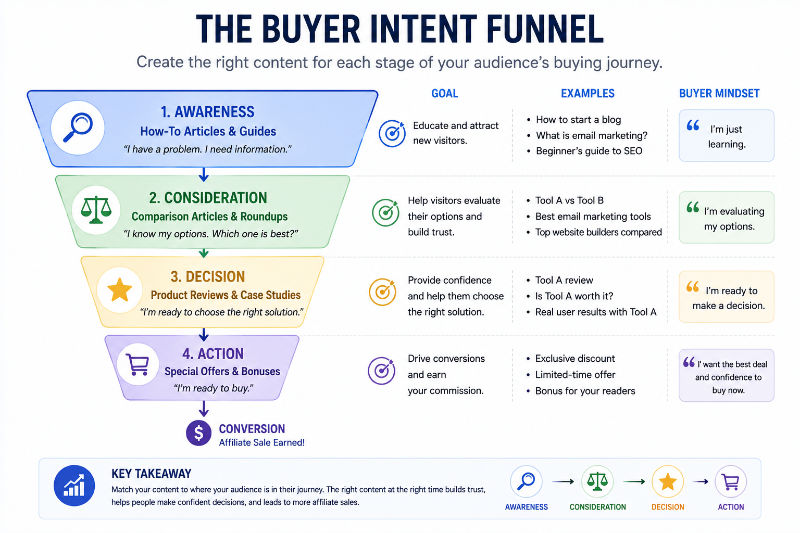
Focus on Helping, Not Selling
This is where many affiliate marketers go wrong.
They try to sell too early.
Visitors aren't looking for advertisements.
They're looking for information.
The more useful your content becomes, the more trust you build.
The more trust you build, the more likely people are to act on your recommendations.
It's a simple principle, but it sits at the heart of every successful affiliate business.
Create Content That Lasts
One of the most powerful aspects of affiliate marketing is that good content continues working long after it's published.
A useful tutorial written today could still attract visitors years from now.
A comparison article can continue generating affiliate commissions month after month.
A review can influence buying decisions long after you've finished writing it.
Think of every piece of content as an asset.
Each article, video, email, or guide becomes another opportunity to help people and generate commissions.
Over time, those assets begin to compound.
That's when affiliate marketing becomes truly powerful.
Now that you know what types of content generate affiliate sales, let's look at the biggest mistakes beginners make. Avoiding these mistakes can save you months of frustration and dramatically improve your chances of success.

What's Next?
At this point, you understand the foundations of affiliate marketing.
You know how affiliate programs work, how affiliate links track commissions, how to choose a profitable niche, where to find affiliate programs, and what types of content consistently generate affiliate sales.
That's enough information to start building your affiliate marketing business.
However, creating content is only part of the story.
As your content library grows, new challenges begin to appear.
How do you avoid common mistakes that cost affiliates money?
How do you track which affiliate links are actually performing?
How much money can you realistically expect to make?
How do successful affiliates organise hundreds of affiliate links across blog posts, videos, emails, and social media campaigns?
And what legal requirements do you need to understand before promoting products online?
In Part 2 of this guide, we'll answer those questions and show you how to move from simply publishing content to building a more organised, scalable affiliate marketing business.
Continue to: Affiliate Marketing for Beginners Part 2: Scaling, Tracking, and Growing Your Income